Leaf 21
Project: Christo's Drape and Wrap
From Serial Monogamy to Blowing in the Wind
"What has once been in relation never fully separates, and keeps acting across distance and time." —
[Elena Bayo, Artemisia Noctis: A Grammar of Darkness, 2026]
I recently encountered Jeanne-Claude's and Christo's [1935-2020] witty, suggestive, and dancing "fiber" sculpture [in a different medium and scale than I had before] at Santa Fe's Turner-Carroll
Gallery.
All this temperamental drama—involving unfurling, stretching, and streaming—prompted me to think again about Donald Judd's cool procession of 100 Cor-Ten boxes at Marfa. And, looking back on that permanent installation, find Judd's tense, exacting industrial containers arousing a new psychological insight. Consider these two different emotional articulations—their divided attentional fixations—one prompted by the starkly-angled box, the other by the waving, rounded wrap. Yet both are monomaniacal. Both possess a knowing artlessness.
Reviewing Judd's unhurried parade of enclosed, monotone, and self-reflecting structures, I remain struck that each rectangular unit marches at measurable intervals. Action occurs covertly or mentally. Some boxes actually shift autonomously. Following large changes in desert temperature between night and day, faint skid marks appear resulting from their almost-imperceptible oblique slide on the floor. Certainly, the visitor's imagination also contributes: visualizing them as blocks in a linked succession occasionally freed to renounce stasis. Almost comically, as in a musical scherzo, these abstract dim or luminous objects enliven with an upbeat character. Thus personified, they prepare to exit through the windows of the long artillery shed in which they are installed. With an intense directionality, they seem to run in step out into the limitless blankness.
When walking close to, and alongside, the parallel rows, small or large surface indentations rise into view. Surprisingly, scalene triangular angles point in different directions, rectangles burrow downward, vertical slots open a narrow geometric cave, puncturing the unperturbable solid below.
As the day wears on, light from the windows captivatingly bounces off the metallic surfaces or buries a side in shadow. Each distinguishing trait or object-attuned particularity is also unsentimentally geometrical as if the introduction of subjective difference required the underlying core structure be protected from any disturbing shape-shifting.
Whatever else Judd achieved in this virtuoso, if repetitive, seriality [aligned rows] of almost identical, exacting forms, for me, this realization was also attended by an ineffable emotion. After witnessing Christo's buoyancy, I found these works not just impersonally industrial but expressive of an unsayable loneliness. We sense an extravagance in the formal repetition, one connected not only to the box's historical authority but to a persistent personal search. This viewer wondered if the self-enclosed box [an abstraction of human mind and body] was the final, sufficient-unto-itself, solution for the artist, or might he, have passed-through to a different vision of the inner life of things?
If the partially-clothed human body inspires the viewer to predict or recall the shape and motion of the covered limbs, what invisible features does the shawled firmness of a building, or the blanketed interpretive stability of an iconic monument, signal?
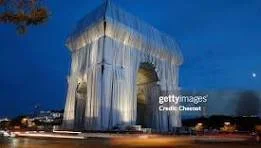
Can curtaining Paris' Arc de Triomphe or undulating across a field, paradoxically, make either more salient? Isn't recognition always an exchange pushing the observer from display to secrecy, public to private, perception to memory? Jeanne-Claude's and Christo's witty recasting of visible parts of our life and environment into beautiful, cloaked enigmas has a fascinating pedagogical antecedent.
The French Academie Royale de Peinture et de Sculpture [founded in 1648 and abolished in 1793] regularly awarded a student prize for the best "casting" of drapery.
That tradition continued in the Ecole and, later, Academie, des Beaux-Arts. Working initially from male models, both painters and sculptors were required to master the technical skill of representing the intricate "throw" of clinging, or resisting, fabric over a real figure. This capture of a textile's subtle rise or fall was intended also to conceal any individual imperfections that were not be copied. The art of "improving" what you drew meant removing any shortcomings or blemishes from what was destined to become an idealized body.
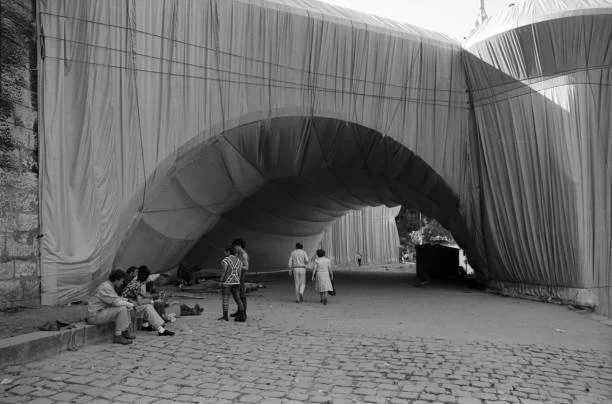
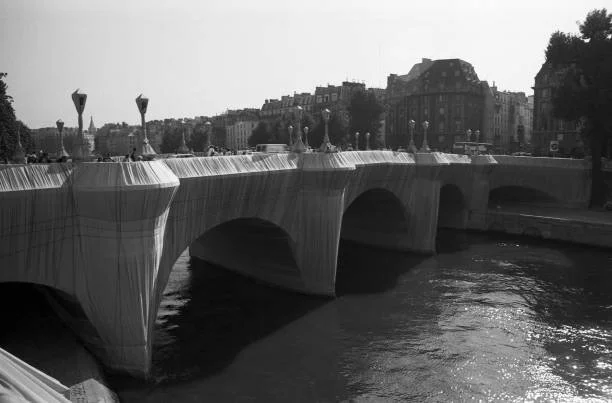
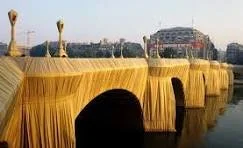
Yet, unavoidably, in this process spills of silk or mounds of brocade also acquired a power, fascination, and character of their own [as in Christo's falling stoles and buxom parapets atop Pont Neuf]. From Poussin to Cezanne [i.e., togas to tablecloths], or Ingres, Degas, to Matisse [i.e., bath towels to filmy curtains], and beyond, the tactile inflation or deflation of diaphanous or textured fabrics, their hang, stretch, or winding could become visually more important than the object they concealed, revealed, or supported.
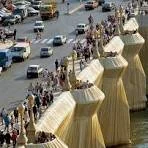
The act of draping or wrapping parts, or the whole, of a naked body was not just an opportunity to hide or blur what nature smudged, but to reveal a new detail or opportunity for an emerging shape. The same principle, here, works to transform the arched urban bridge into an urbane cotillion of fashionable and glamorous evening dresses.
Striving their way to perfection, mythological, historical, portrait, genre, and still-life painters variously wrestled with the self-expressive nature of unruly cloth: glossy taffeta skirts, crumpled military uniforms, roughened leather, stiff lace, creased linen, pleated muslin. Classically-inspired landscape painters from Claude Lorraine to Monet, for their part, wreathed temples, trees, flowers, grass, and water in diaphanous veils of light turning reflection into a gleaming ethereal object.
The revealing Turner-Carroll exhibition of complex mixed-media "sketches" [fabric, twine, cardboard, graphite-augmented collage-lithographs] of Christo's monumental wrapped sculptural projects evokes this history of draping—not as erasure but as creative opportunity—to free something to become other than itself. But it can also emphasize what makes places and things even more like themselves.
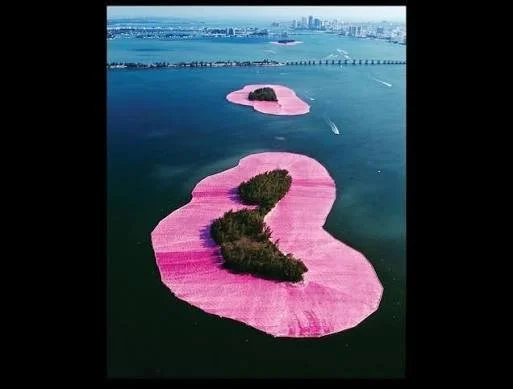
In short, what can temporarily vanish under artful covering [the reverse of destruction] is prior artistic intent, predictable forms, and past interpretations. Public Art invigorates and delights! It also creates Chamber of Commerce razzle-dazzle. Miami's spotty, easily-overlooked islands, when luxuriously-necklaced in frivolous pink—like gigantically-petalled water lilies—momentarily risk kidnapping the viewer's attention from the flashiness of Sin City and its turquoise-ringed beaches on the Atlantic Ocean. Flush with unbusiness-like color, this unnatural nature augments the vision of Miami as synonymous with unrestrained, exuberant fun.
Closest to Judd, in a dishevelled way, is Christo's Lower Manhattan. Aptly, a universal cardboard box filled with soft white packing sits in the center of the Gallery-space—cleverly fanning out the flattened and addressed cardboard sheeting that held the original mailing of the lithograph. Box to boxes! This—as all the exhibited pieces are—is a mixed media scene. The high-rise at 2 Broadway and 20 Exchange is picked out from the architectural crowd lining the Harbor by transforming the building into a white low-relief package with strings. Visually set apart from the host of brick industrial buildings and short-stack skyscrapers, it inspires curiosity. Why this one? Does it promise a new architectural feat? Who remembers what its condition was before wrapping?
In Chicago, Josef Paul Kleihues' [in collaboration with Dutch architect Rem Koolhaas' firm] constructed a fearsomely stark building which, when draped, revealed the triangular prow of a ship—sails flared—cresting down Michigan Avenue to the Lake. Happily, it was substantially shored up by Chicago Avenue to the South and Fairbanks Avenue to the West! In the lithograph, the twine holding down the flaps also creates a vast canvas for shadow and light plus welcomes a symbolic billow of fabric from a gust of famous Chicago wind.
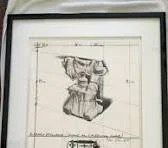
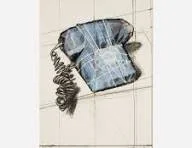
Special "minor" genre objects also receive revelatory draping. Kirchberg Spaetlese is monumentalized both in profile and when tilted head on. Even its crookedly-leaning cork becomes yet another provocative object on top of a distinctive wine bottle. More dramatic, is the canonical black telephone with its serpentine cord sensuously looping down.
The dial face is obscured with translucent polyethylene wrap [denoting the desire to silence it?!]. Its suggestive shape is collaged with fabric, held with staples, sexualizing a standard office object into a broad-shouldered, narrow-waisted, and voluminous-skirted female assistant.
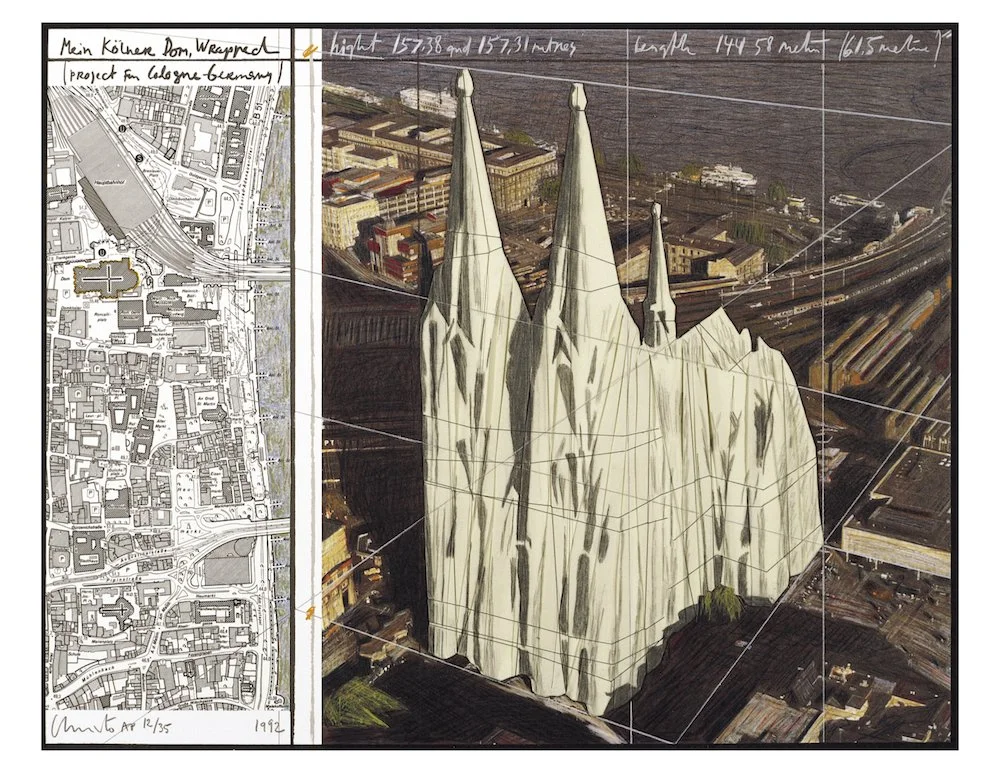
Christo figuratively "rescued" Cologne Cathedral by figuratively holding together its mouldering twin towers and West End through pictorial tightening [with twine].
The trees lining the Champs Elysees and the Rond Point, unspooling towards the Arc de Triomphe, had their gasoline-fumed leaves enveloped in polyethylene turning branches into pollution-protected, pollarded shrubs: all part of Christo's restoration portfolio, Five Urban Projects.
My personal favorite is not Christo's pleating of floors, or placing an inscrutable package on a table, or even the fluttering punctuation of Running Fence [disappearing into the distance], or Central Park's brilliantly-orange suspended Gates. Rather, it's the amazing sketches for the never-wrapped Munich Glyptotech's east pedimental sculpture from the ruined Temple of Aphaia [late 5th century BCE] on Aegina, metaphorically evoking the first sack of Troy. In the screen print of this superb triangular scene: think shield-raising, dying warrior to apex of majestic, calm Athena, to coil of struggling combatants, we see that gods and epic heroes have been mysteriously changed into flaneurs in a genre scene.
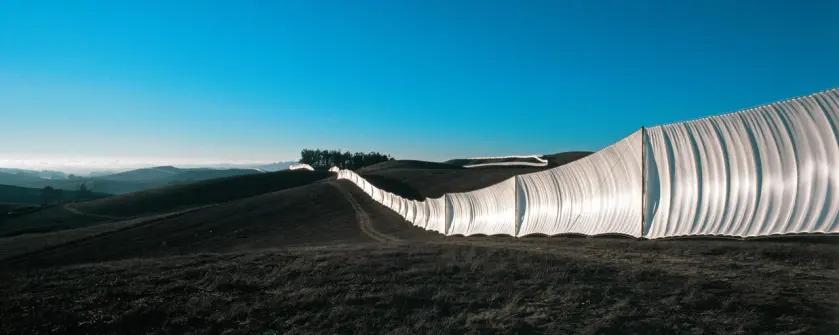
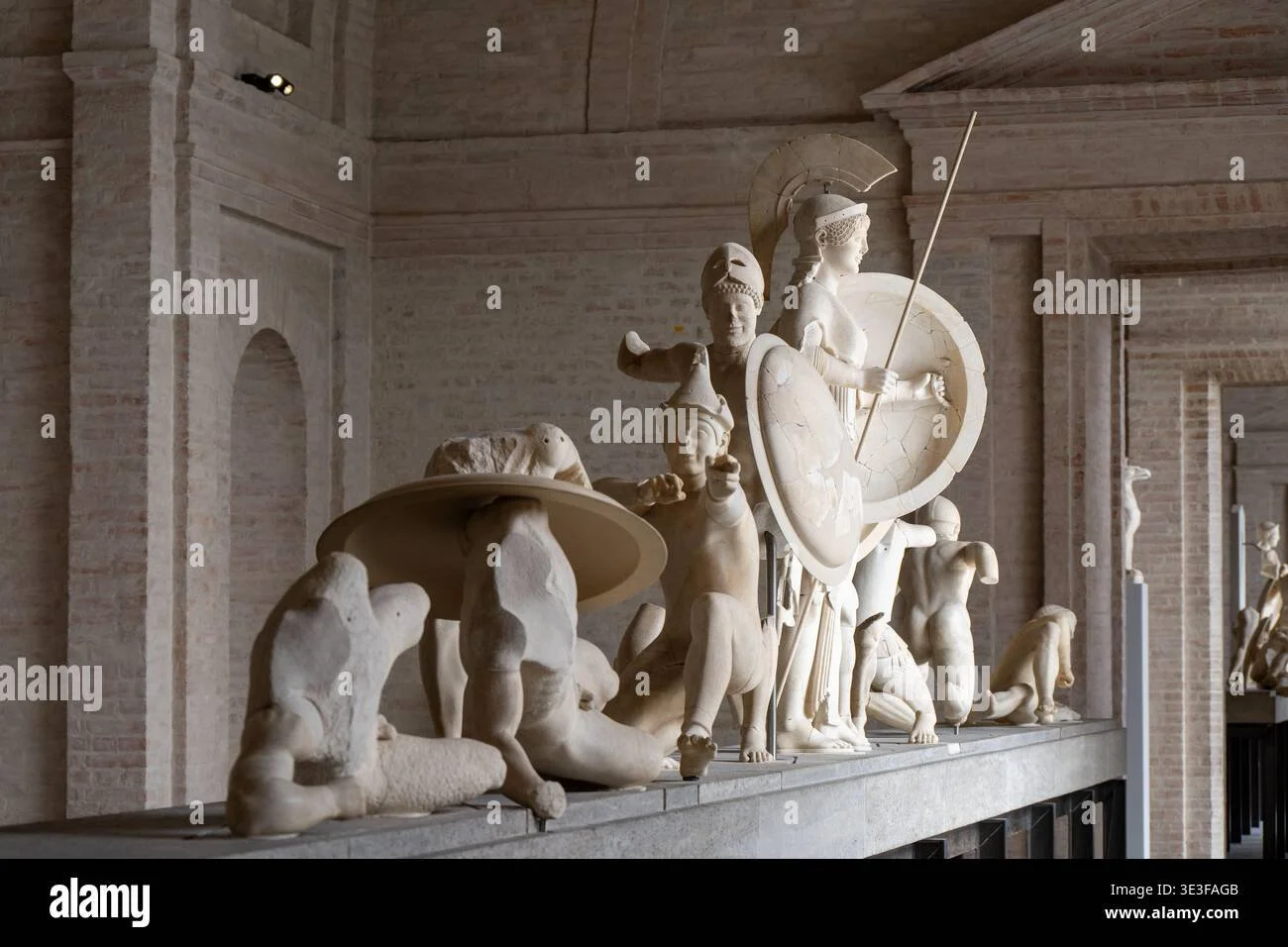
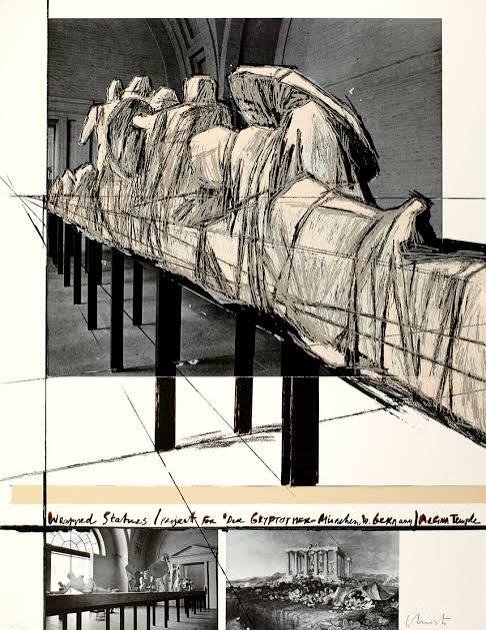
Imagine an Impressionistic bus or train ride or marchers—with one sheltering under an umbrella. In short: a complete transfiguration of the beautiful fallen and fighting figures. Not the approximation of absolute and unimitatable forms in a destroyed city, but a new cohesive identity. Not amorphousness, or a vague procession of heavily-photographed heroes and gods, but the surprising assertion of ordinary beings and everyday objects empathetically discovered in an eternally-recognizable relationship.