Leaf 15
“Where be the Maize/ Where be the Haze/ Where be the Bur? Here said the Year.”
-Emily Dickinson, ”Answer July”
[Ximena Garado-Lecca at The Santa Fe Railyard Park-Waffle Garden]
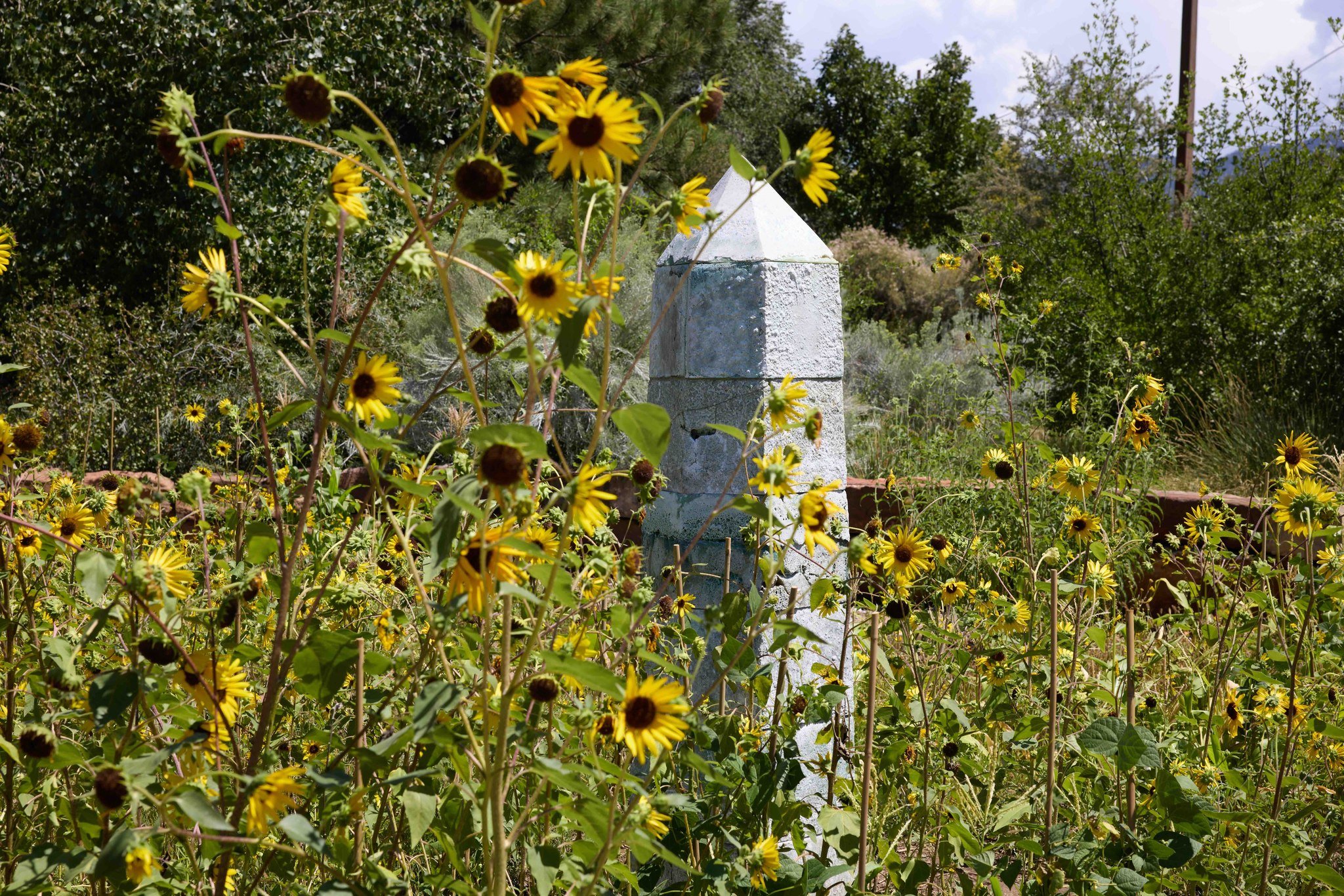
from https://www.facebook.com/sitesantafe
Photo Credit Brad Trone
Whether simply a natural ending, or not, the fifteen venues of Site Santa Fe wear the pathos of the untended and the unobserved. With a month to go before the entire event [the first since 2018] closes, the installations already display the knocked-down look of Kassel after Dokumenta or the shuttered appearance of Venice after the Biennale. Although not always great, those vibrant venues retain their exceptional draw by convincingly showcasing the revelatory promise, as well the compelling intelligence, of forceful art-making. What, in sum, has emerged at SSF? For dedicated viewers, the big question is: Were these evacuated spaces ever more than convenient vacancies to be filled without passionate intent?
Heading out to my last site, the mood of the place is now one of spreading emptiness: the sad passage of something not fulfilled. Of all the town or country distributed locations, this living installation lies closest to the mother-ship. Drawing a full circle, you might say. The main Building acts as the conduit releasing diverse media and materials into the world. Running parallel to its lengthy, windowless flank—and camouflaged within the tangled Railroad Park Conservancy-- is a wooden-post and steel-beam “arbor” seasonally swagged in dried, twisted vines. This industrial cut is twinned by a lower dirt path bordered by a rugged- stone wall. Textured “Santa Fe Copper “boulders, scattered fallen logs, the odd metal bench, Juniper loaded with indigo berries, and fuzzy, snail-infested Chamisa, make up this abandoned space. Visiting on a late Fall day, and looking to my left, two homeless men were sitting or sleeping in the shade of graying bunches of blue grama grass and bronzed Cottonwood trees. On the right, the brick path shot past the modern Water Catchment Building and its cluster of overturned picnic tables to open, finally, onto the angled view of a forlorn corner in the Railyard Plaza.
Continuing straight ahead, the visitor detects an otherwise invisible patch of ground left of the road intersecting the unfurling walkway. Perhaps something intriguing? During high summer, this secluded spot would have been hidden in dense thickets. However, the flourish of a sidebar: a tunnelled wall of red sandstone and a heap of iron-oxidized blocks, alert the viewer that, at last, something promised will be seen. Something environmental-- contained within a low ashlar circle--persists under leafless trees. Peruvian artist Ximena Garado-Lecca’s ecological fascination with Andean and Mesoamerican dry farming methods, or agrarian “Waffle Gardens,” results, here, in a secretive enclosure with a waterless, legacy acequia running through it. The corn planted in the spring has degraded into rotten husks and shrivelled stalks. Come December, will the artist burn or rake? Come May, will someone plant again?
One needs to see double in this desolate spot since the artist delivers two messages. First, there is her redemptive view about the future of climate change. Second, she reframes a potentially -recurring moment of historical destruction. A stratified glass-cast obelisk rises, off-center, from the rock-ringed soil. This ancient triangular form-- commemorating personal death longing for resurrection--ranges from the Egyptian pyramids to the 2020 toppled Soldier’s Monument. Composed of Trinitite--the vitreous radioactive material from the fused, greenish detritus left behind by the Trinity Test—it serves as a resonant emblem of New Mexico’s first atomic bomb explosion. The blasted and bisected middle layer exposes a scarred rubble core. By analogy, the exploded earth is being urged to reopen itself through an event-based work. Perhaps, then, rather than July, Fall or Winter are the most symbolic times to view this decayed “garden.” Approached from the side and seen cruelly aslant, as well as unavoidably closeup [not remotely cratered from above], this “wounded” land seems attuned to a melancholy time of year.
Returning to the adjacent SSF Building, the Lobby Store now brims with piles of last-minute, thick Once Within a Time books digitally printed on recycled paper. The contents repeat the wall text. Remarkably, in my wanderings, I never encountered an administrator or curator. Perhaps this is just the chanciness of chance. To the best of my knowledge, the only public Artist Conversation [featuring Eliza and Nora Naranjo Morse] devoted to portions of this large and sprawling exhibition, was bracingly introduced by the Wheelwright’s Executive Director, Henrietta Lidchi. And, notably, the occasion was sponsored by the always-supportive New Mexico State Committee, National Museum for Women in the Arts. What it lacked, however, from an audience point-of-view was the presence of a SSF curator to moderate. Two hours of self-generated talk made it obvious that the speakers could have been respectfully and revealingly drawn-out by the exchange of knowledgeable, interested, and pertinent questions. That is the counterbalancing diplomacy of curation.
One wonders how SSF would have been organized and run if, the in all- ways elegant Suzanne Ghez, past Director of Chicago’s Renaissance Society and profound curator of small and large spaces had been consulted. She understood in her bones the intense work and omnicompetent responsibilities of great curation. I am thinking of the absence of arrogance or inaccessibility, the production of unexpected delight, the invention of thoughtful installations, the arousal of curiosity, and the continual asking of what makes something art. That is, she mastered a persistent focus on excellence, careful selection, placement, spacing, attentiveness, maintenance, and mentoring. In this massive and lingering project, the people who must be commended are the dedicated and enthusiastic young docents deployed to different locations as well as the sustaining staff.
This is my last SSF Leaf. So what can be said about these temporary, distributed, and difficult-to-find installations? Many do not originate in 2025—having been created earlier for other purposes. Nor are they easy to resurrect in memory. Nor do they tend tantalizingly to linger afterwards, giving shape to our daily lives. Might public panels or speakers have aided information- dissemination and communication? Having visited this sometimes baffling assemblage of objects and images over a concerted period of time-- mornings and afternoons, early or late in the week, with other visitors present or mostly not, under clear, cloudy, even rainy weather conditions-- I was struck how artefacts and places slid away-- over the six- month duration of this major exhibition. What sticks in mind for this determined viewer is not any wide vision. Rather, it is the materializations of singular intelligence, surprising insights, stunning expertise: wonderful, intangible and tangible things that changed my view of the world. I was indelibly reminded what qualities and characteristics anchored my love of art.