Leaf 17
Psychogeography: Predisposed to Hiding Things
[Lewis Hawkins, Four Seasons Hotel (The Golden Age, from The Four Ages); Time Stabbed; Self-Portrait]
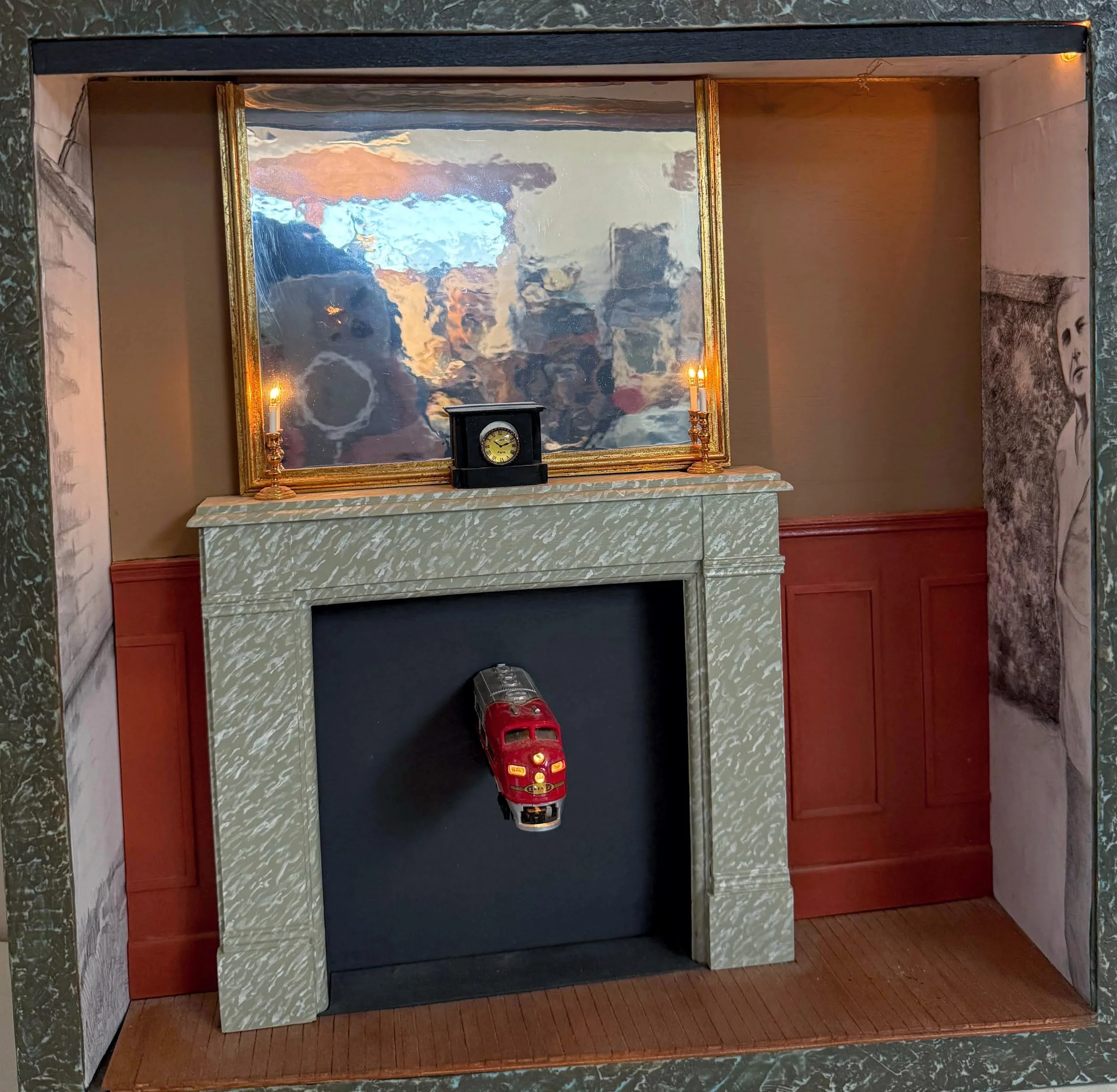
Five iconic objects tend to rule these civilized/uncivilized spaces: moon, menhir, ladder, chair, nude.Step ladders rise toward the moon or flank the nose-lit red Santa Fe Diesel bursting out of an elegant Magrittean fireplace. Above its speckled mantel gleams a shifting mirror reflecting an azure sun- or star-studded sky while the locomotive’s eerie shadow inches forward on the floor depending on the time of day. And to the side, an allusively- cornered drawing of the staring Copernicus attests to the arrival of a new universe. One can think of these enclosed interiors as Rousseauean: Visual thoughts or associated reveries floating in, with, and through time.
Consider how the bulbous, anciently worshipped Venus of Willendorf nods remotely across the studio space at a languorous, barely-draped Venetian courtesan. Permian red rock devolves into an Andy Goldsworthy Yorkshire gray stone wall. Architecture old and new structures the entire lot. It undergirds the multi-tiered, delectable cream torte in Take a Chance/Take a Spin. It subdivides exquisitely designed inner spaces into, for example, an iron- bridged pedestrian upper- walkway—populated with curious strollers-- set against a leafy garden lit from above. The bottom half, on the other hand evokes a triple-arched eighteenth-century collector’s salon framing a marble statue of Venus and Amor.
Formally, the box is about creating limitations in space. It embodies an object demarcating itself from its surroundings—up to a point. Recall Hawkins’ use of the mirror to bring the external world into a scene as well as to multiply and intensify our visual perceptions. Or think of his insertion of partially-concealed, crypt-like sub-basements in certain scenarios so that one must bend to activate such emotional locations for our senses. Sir John Soane’s dramatic dialogue between dissolving light and corrosive shadow in that mysterious tripartite environment of ruins, the London Soane Museum, comes to mind in its psychological impact on the viewer suggested in Hawkins’ Civilization on Civilization. While the mass of architecture can give the impression of the solidity or gravity of matter—this impression of stability is undone by Hawkins in a Modernist way by the self-assertive resistance of the unruly and antithetical jumpy images.
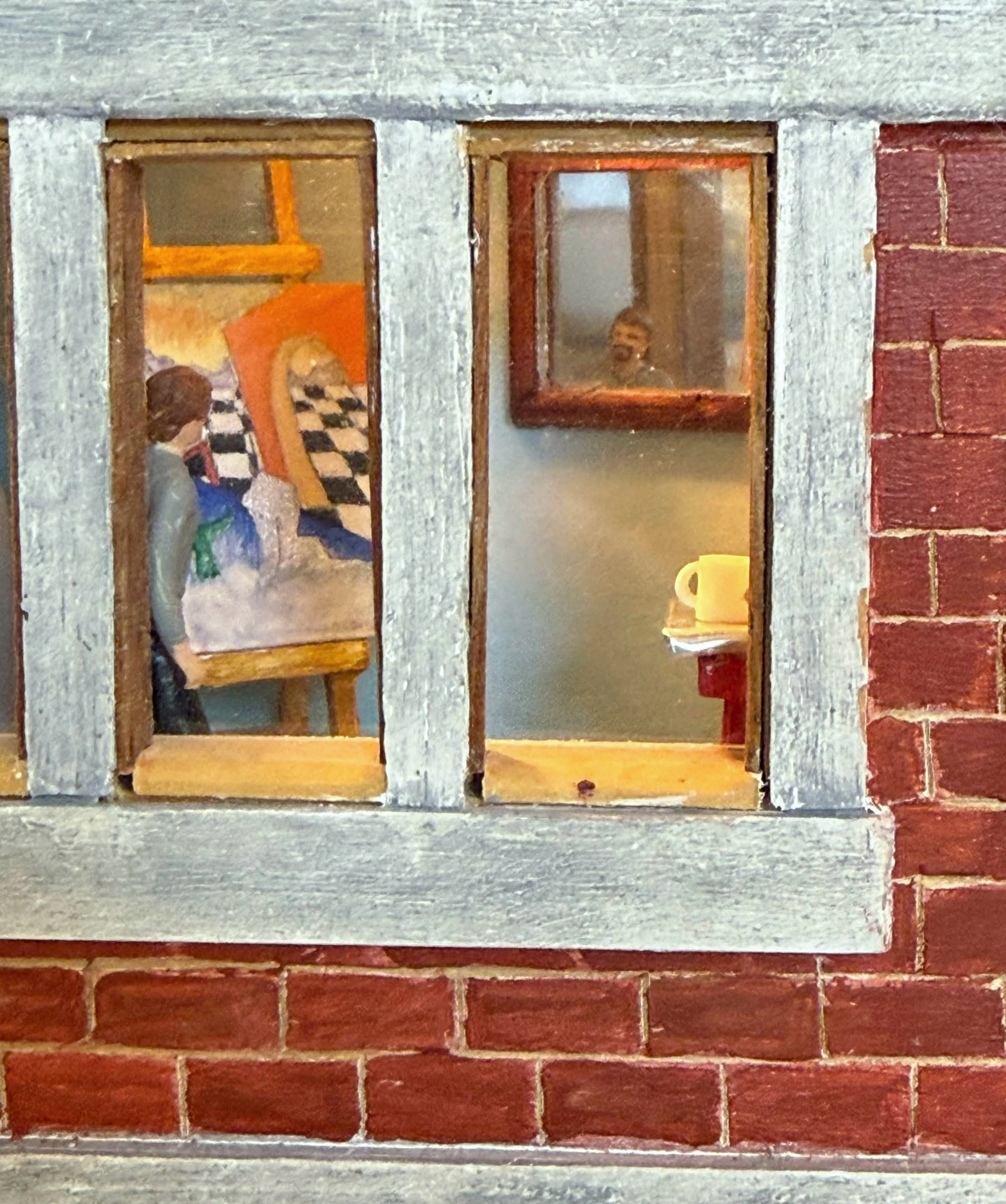
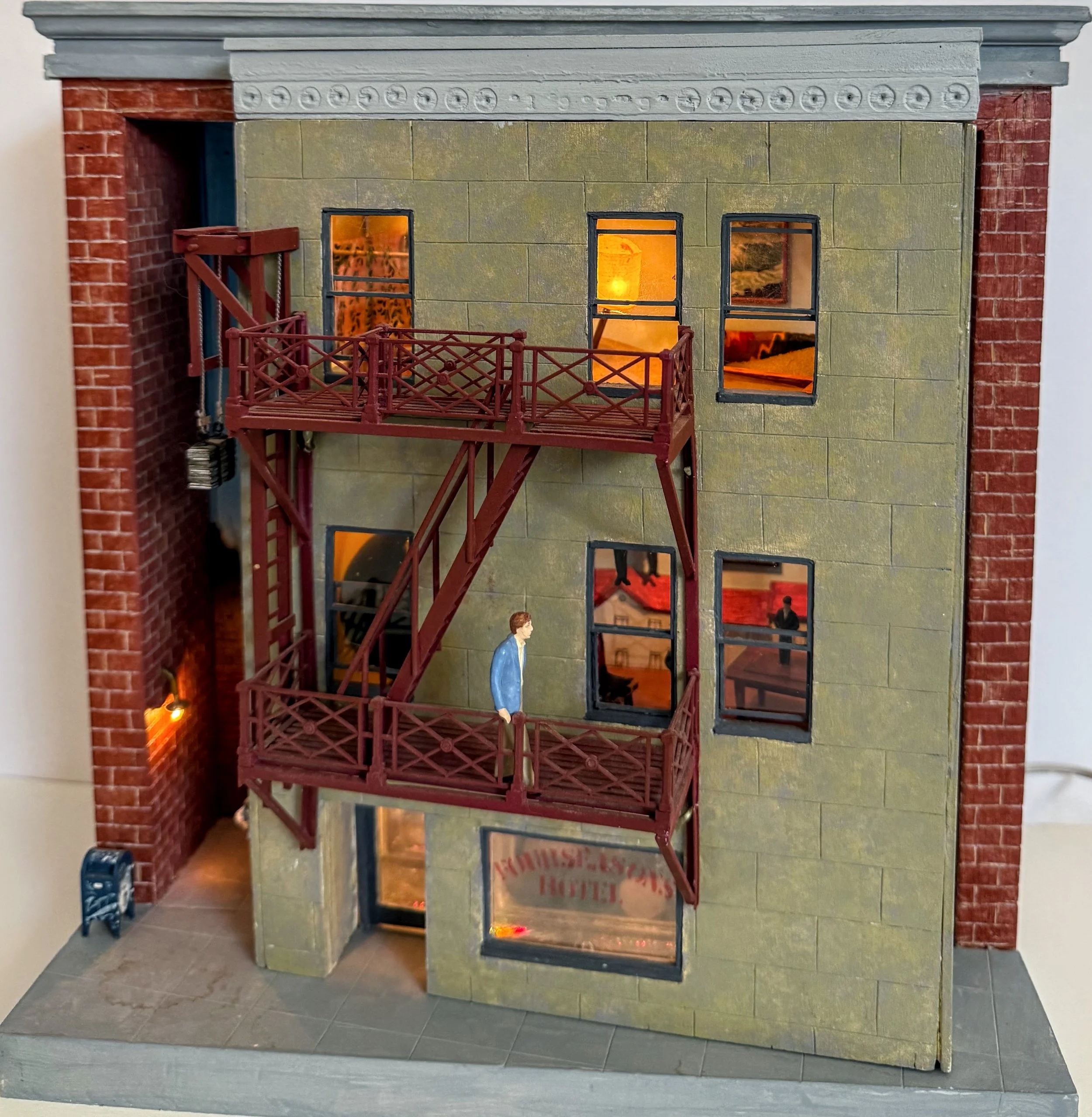
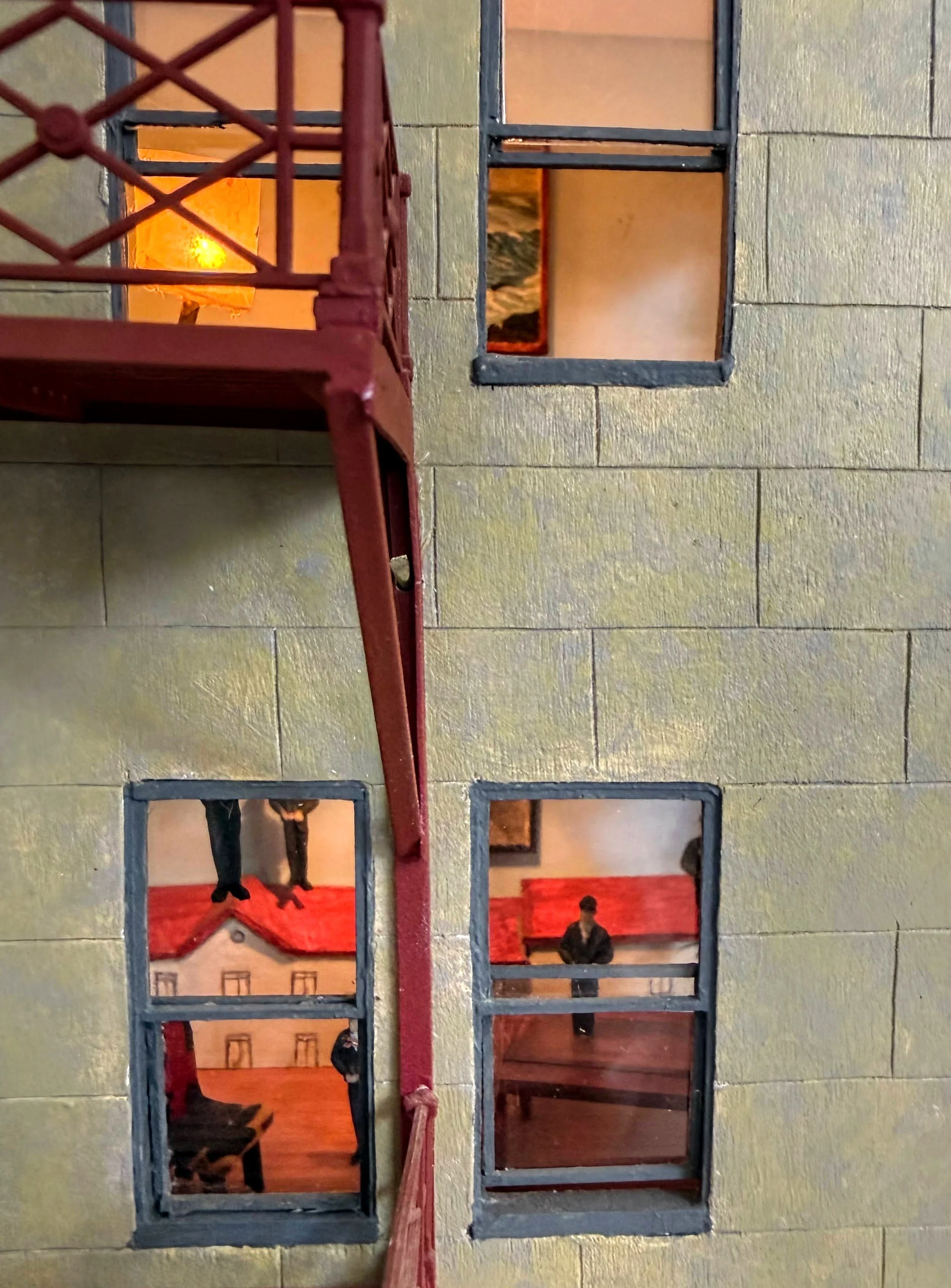
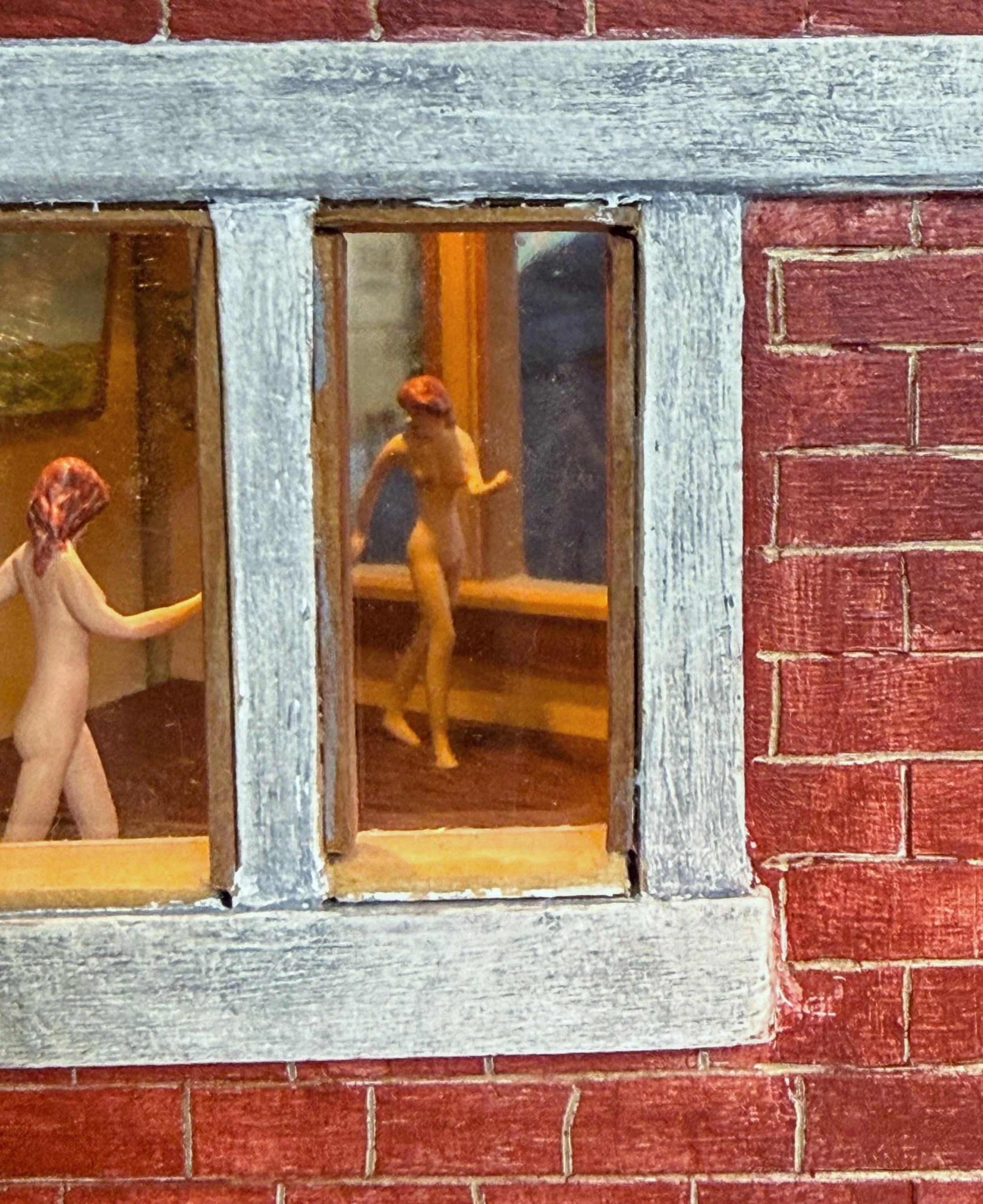
What is the character, then, of his boxes? Why do they make us pay attention? How and why do we animate or interpret them for embodied selves? Consider the gridded [complete, of course, with flight of steps] fire escape accompanying the façade of New York’s Four Seasons Hotel. Constituting the The Golden Age in the Series, The Four Ages, it reveals, on close inspection a naked woman glimpsed through a window. The artist’s Self-Portrait is his six-windowed studio [on the left] visible behind the looming brick wall.] Peering through the panes, the viewer sees a canvas; the artist’s yellow coffee cup. And on the right of this box, rises an exploded view of interior including a flutter of drawings, paintings leaning against the studio wall, and the red tilted table repeated in a hung painting. This complex archive of an artist’s interior is echoed in the repeat black and white pattern of the tile floor. But its interior is repeated floor to ceiling on the right of the box. And a red table covered in paint pots and an “L” aptly-inscibed coffee cup juts provocative into our space. The miniaturized paintings visible through the studio windows are, here, blown up to complete this Bohemian interior.
[i] John Fowles, The Magus. A Revised Version [New York: Dell Publishing, 1978], p. 9.