Leaf 16
“What is it I will have left when I leave, little but the milkweed silk,/My inky fetishes, my spirit-papers and my urns . . .”
-Lucie Brock-Broido
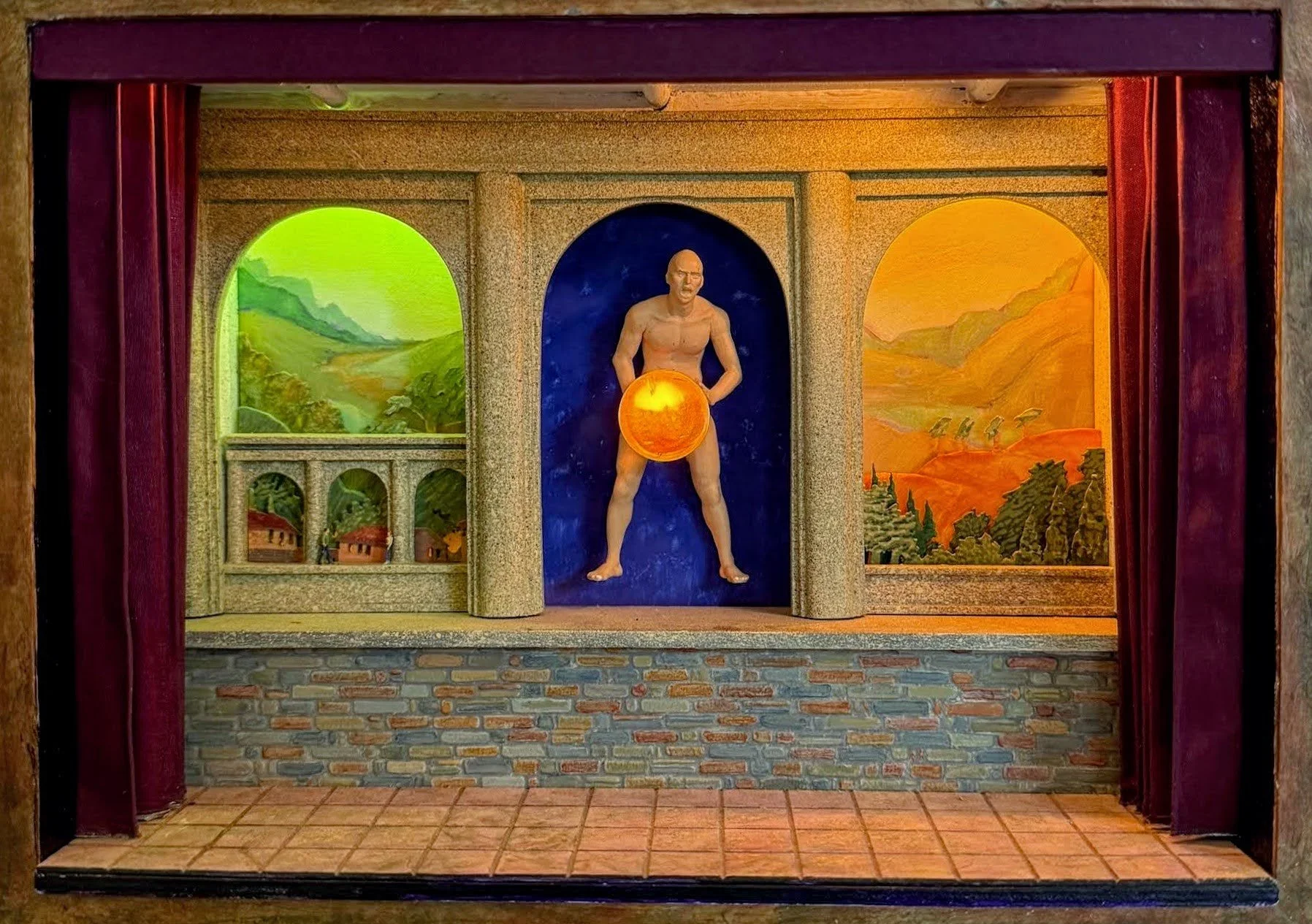
[Lewis Hawkins, The Magnus, mixed media with lights]
Magritte and Confabulation
Boxes from Wonder Cabinets to Leica cameras rescue the world’s leavings from the predations of time. While the real moment and its tangible matter has expired, their combined memory can undergo visual reshaping, an inventive resurrection from loss and forgetting. At least since the Egyptian tomb and its mummified caskets and urns, the fact of enclosure could also insure an individual’s subjective narrative coherence. The act of transforming vanishing phenomena into life-like effigies of what once was [ or might possibly have been] demands a fantasy-arousing container capable of awakening the seen from the unseen.
None better than the Surrealists understood how to paint or photograph or sculpt recognizable objects as encrypted in mystery. As Rene Magritte [immuring house], Salvador Dali [window -frame paintings], Giorgio de Chirico [empty piazzas], or Man Ray [ “moving sculpture” flapping clothes set against storefront] demonstrated there is nothing that turns an ordinary object more uncategorizable than a definitive architectural enclosure.
South of Santa Fe on the winding Turquoise Trail, off Crazy Rabbit dirt Road, in a low, veranda-hung house he designed and built, Lewis Hawkins creates secretive boxes mounted singly on shelves or pedestals. Like the conjuror-writer John Fowles, Hawkins is the enigmatic Magus [1965] whose works embody a cerebral game, an erotic adventure “in a domain without name,” and the visual evocation of something marvelously inexpressible. [i] All portend that something is poised to happen. Some are sagely self-contained. Others allow their Vermeer black and white tiled floors to angle out dangerously beyond the horizontal restraining edge. Still others rakishly protrude beyond the ornamented roofline, willfully escaping artistic domination. Everything—from the grained wood or hand-made paper, the beaten copper or montaged frames, to their painted, drawn, photographed or collaged contents, as well as tiny stone or mixed media figures and decor—are crafted by the artist. While they exist and are present personally for him, they entice viewers precisely because they also address our illusions about desire, absolute knowledge, and the unknown.
The visitor is made aware there are more secrets than can ever be divulged. It takes time to realize that a backdrop flap opens to reveal a reclining Titianesque nude, or that behind an at first glance seemingly blank studio window stroll naked models, or that a miniscule bathroom exists behind a brick wall, and a tiny studio duplicates larger pictures“hung” outside. While the three-dimensional front of these rebus- containers variously extends or withdraws into interior space, their abstract back is intricately interlaced with labyrinthine wiring that wittily sheds light on the ambiguous foreground scene. These abstract arabesques on the reverse side form a contemporary commentary, a sort of schematic pattern- generation, slyly echoing the 3-D compositions undergirding the proscenium scenes.
Some two-dozen or more differently- scaled, and in different states of completion, relief and free-standing boxes compete for the viewer’s attention in the artist’s two-storey studio also rife with abstract paintings large and small. Many of these chromatically vibrant geometries are also recognizably compressed within these three dimensional theaters. In this sense, these boxes are reminiscent of “toy” eighteenth-century pleated-paper stages adorned with print views and side-shifting sets that advance and recede. This dramatic and provocatively dense environment is further enlivened by the studio’s floor-to-ceiling book cases stocked with found and created miniature “still lives” awaiting future absorption into larger personal and cultural myths. Not unlike Magritte’s views of a darkened house lit by a single haunting light or an umbrella-strewn blue sky, these objects launch an emotional strike before we understand what it is. Their mysterious pull owes to the maker’s powers of confabulation: the stunning instants of disorientation uncoupling a sharpened reality from a liberating irrationality.
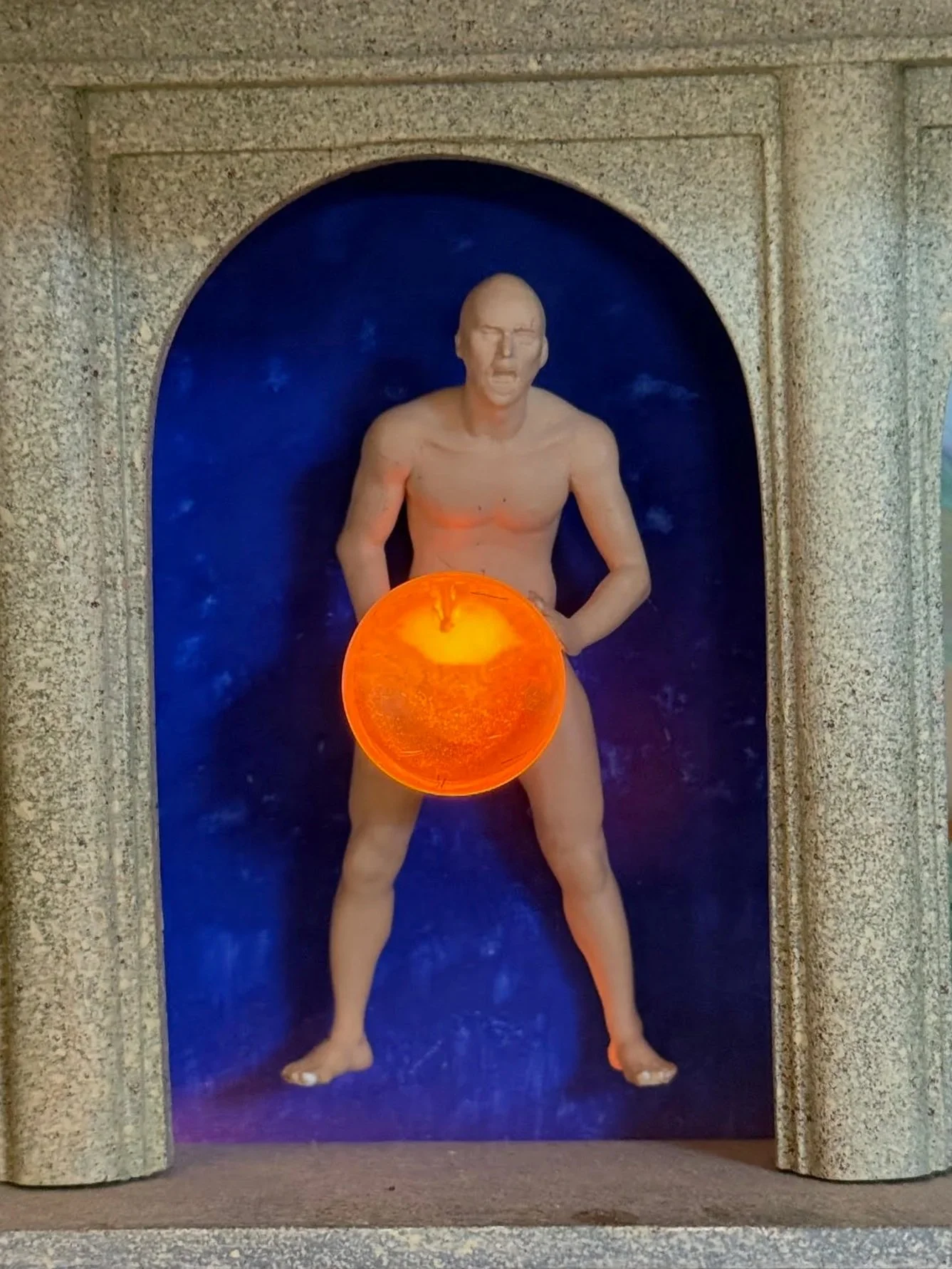
Photo by Lewis Hawkins
[i] John Fowles, The Magus. A Revised Version [New York: Dell Publishing, 1978], p. 9.